Archival Map
The Belerion Tin-Ford, Tidal Pool, Sand-Spit, and Outer Black Rock
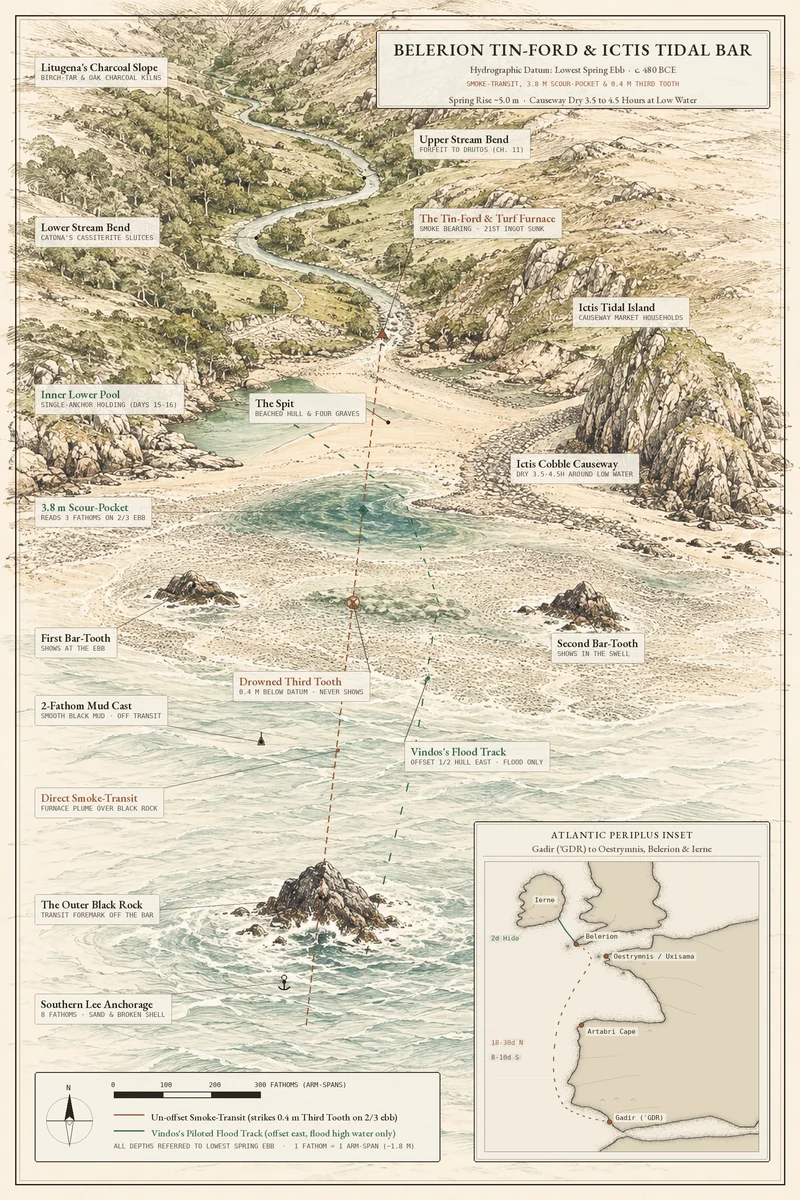
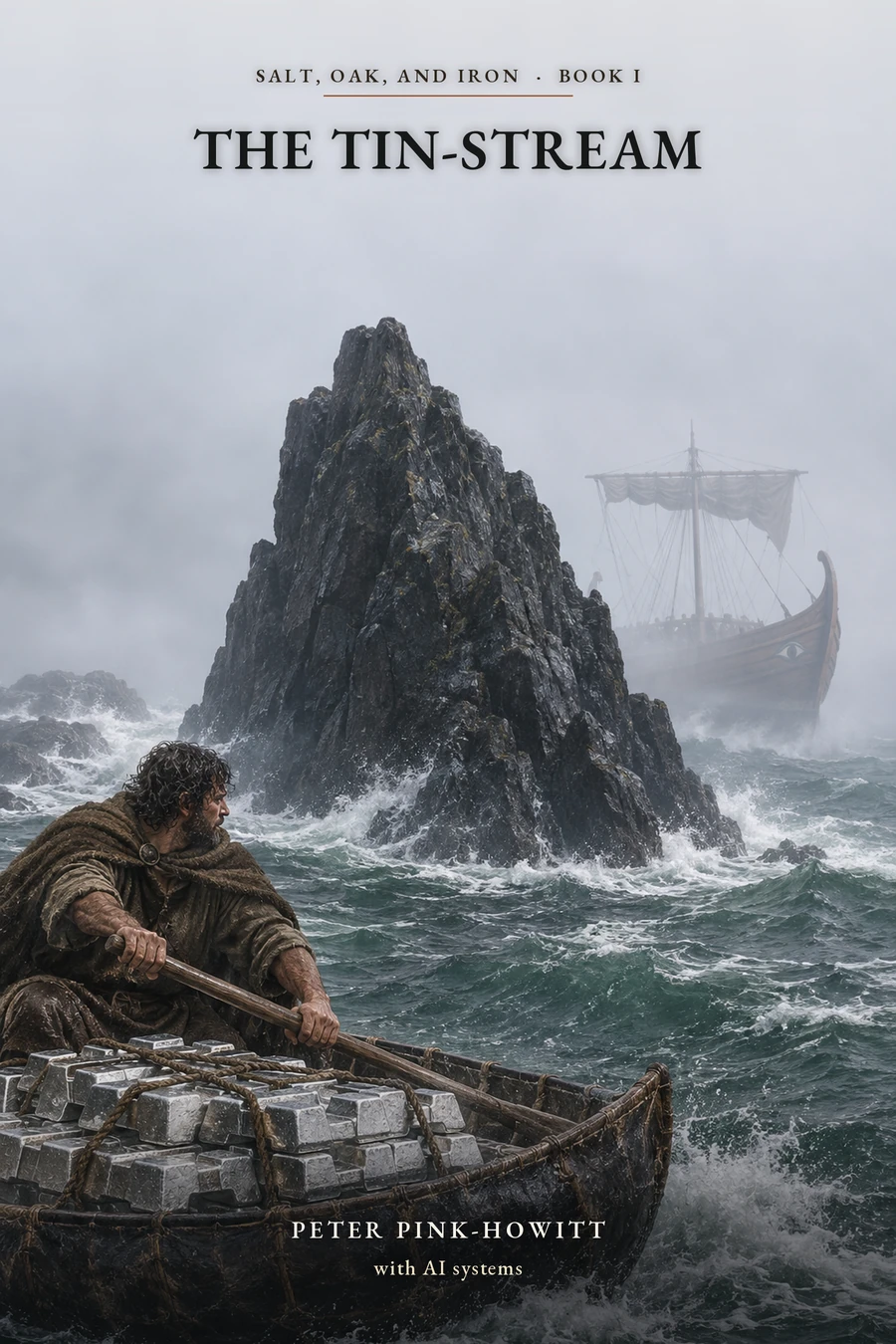
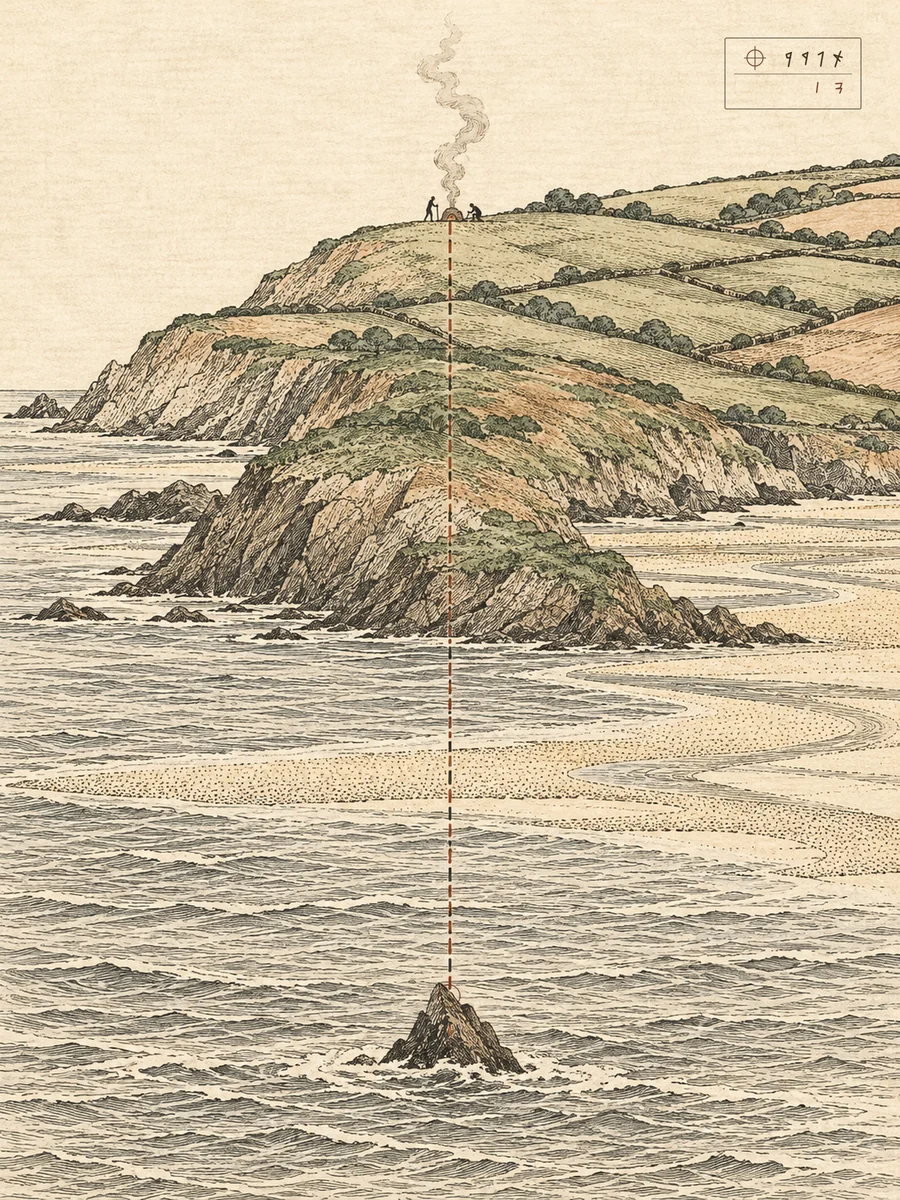
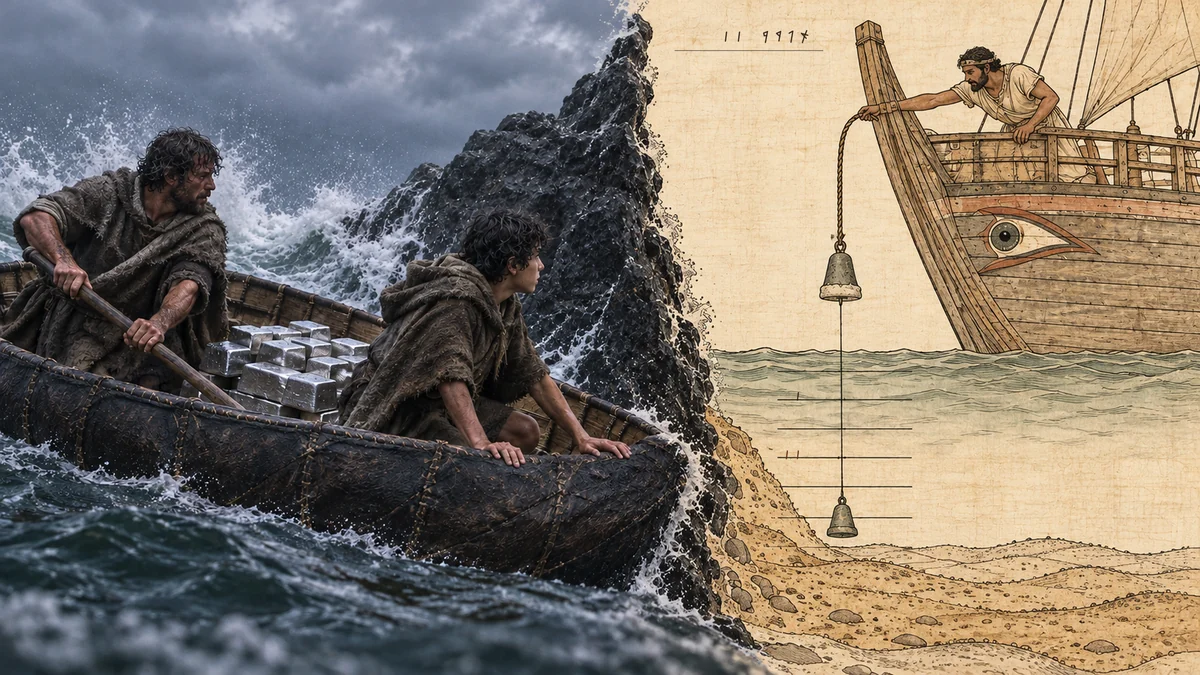
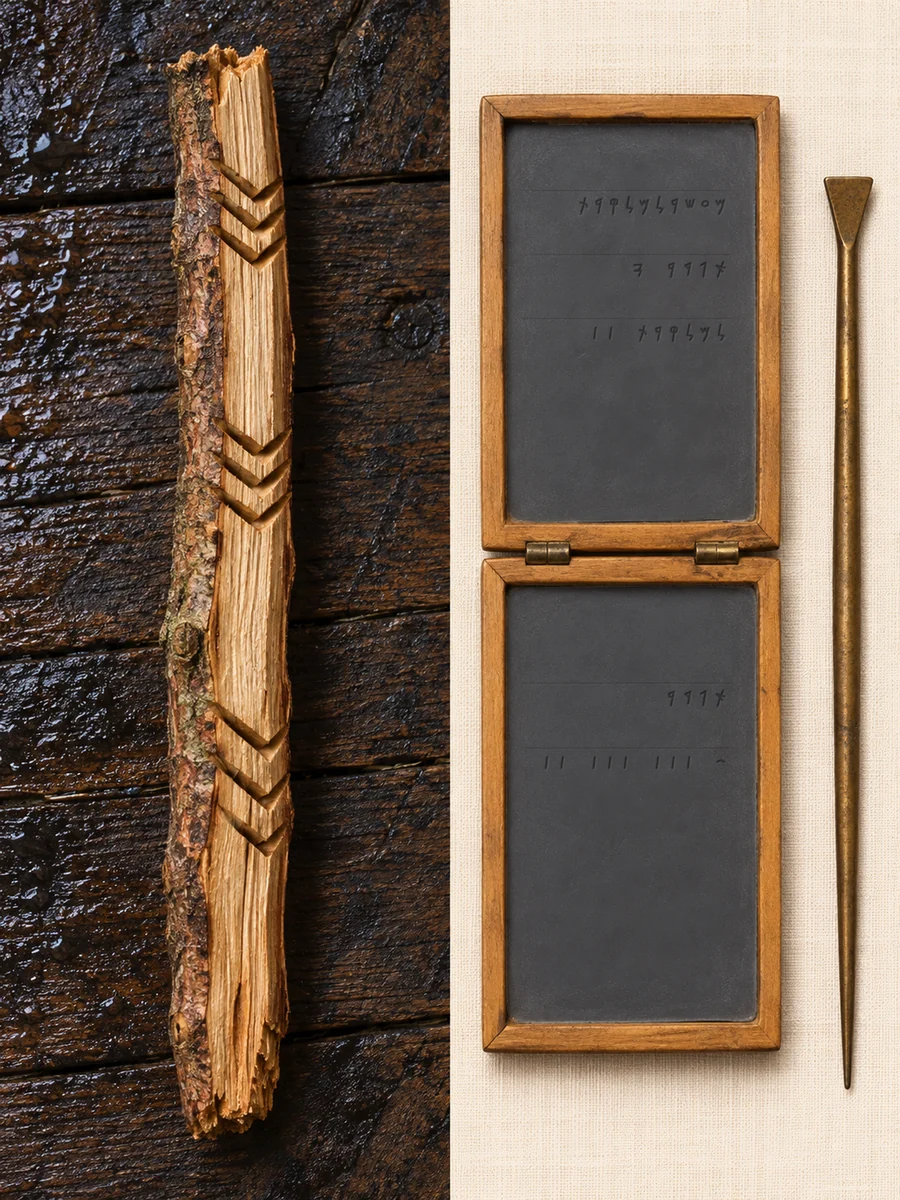
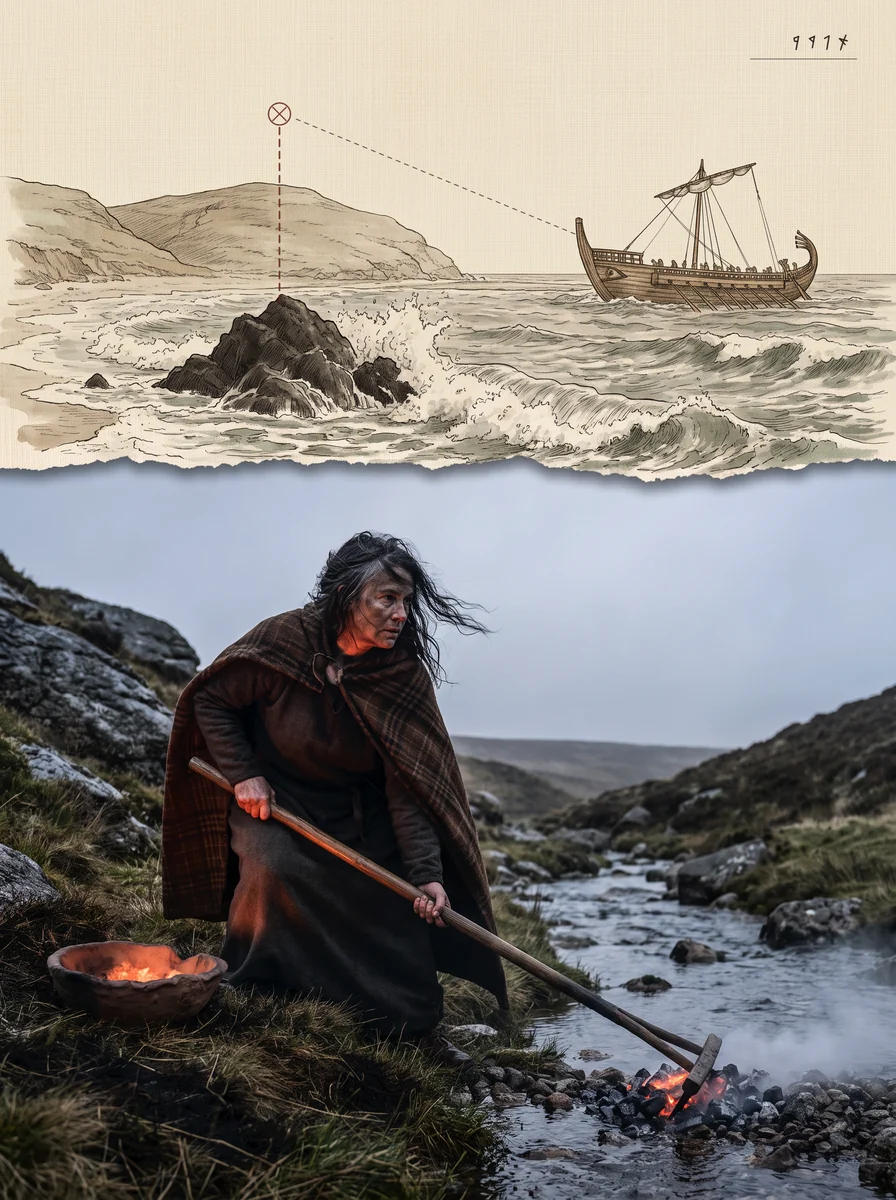
Around 480 BCE, Dumnonian stream-smelter Catona casting four-lugged tin ingots and Oestrymnic pilot Vindos in his seven-hide stitched ox-skin curragh confront Trierarch Shafat's fifty-oared Gaditan ship and young Tartessian clerk Arganthon across a concealed granite bar in Belerion. Across twenty-two chapters and a northern Coda (101,028 prose words plus a 2,697-word Historical Note), split hazel tallies, tallowed sounding-leads, and a two-column Punic wax diptych test what an ocean road costs to write down and what it costs to smooth blank. Accompanied by an archival Belerion estuary map, seven Medium C dual-channel plates (including three panoramic spreads), and a 128-concept Ancient Scripts and Epigraphy Studio.
Shafat counted the water before the anchors had finished taking up.
Nine jars were full. He put his palm on the pitch of each stopper and then on the shoulder of each jar and found the seals whole. Four were half full. He had broached them himself on the crossing from the Artabrian cape and he knew to the cup what was in them, but he lifted each one a hand’s breadth off the hold-boards by its ring handles and set it down again, because a jar knocked in the race off Uxisama could have wept through a crack that did not show in this light. None had wept. Eighteen were empty. They lay lashed low on either side of the mast-step with their stoppers in, for ballast, and he counted those also, from the bow aft and then from the stern forward, and the two counts agreed.
Thirty-one jars had left Gadir sealed. Twenty days of sea had taken twenty jars out of them at the full ration, and the stoppers of the empty ones had been pushed back in as each was finished, so that the hold would not smell. The last time the men had drunk from the ground was at the Artabrian cape, eleven days behind them, where the spring ran thin and brown under the cattle of the headland and Shafat had let the crew drink their fill from it and had filled no jar. On the Oestrymnic headland there was a spring under the turf wall, and the headland people had stood across it with their spears grounded and their wives behind them and said, through the boy, that the water was not for wooden hulls. Admiral Himilco had not argued with them. He had watered the squadron from his own reserve and gone south to look for a better landing, and he had sent this ship north behind the hide boat of the pilot the headland people had sold him.
Shafat came up out of the hold.
The anchors had both taken. The bow anchor was a stone with two oak stocks through it on a hawser of Gaditan hemp, and the stern anchor was the same. He looked at both hawsers where they went over the rail and found them lying without jerk in the swell. The ship lay in the southern lee of a black rock, in eight fathoms, on sand and broken shell, at the top of the flood. To the north the land was low and green and brown. There was a river-mouth, a bar with the water breaking white on it, a sand-spit, and beyond the spit a marsh. On a slope above the marsh a column of smoke stood up, grey, without bending.
Bostar was at the mast with his arms folded.
“Nine full,” Shafat said. “Four at half. Eighteen empty. That is eleven jars of water, and there are fifty names on the bench-muster.”
“Eleven,” Bostar said. “I’ve been counting them in my sleep since the cape.”
“Then count them awake with me so that nobody can say afterwards that the ration was not told.” Shafat raised his voice enough to reach the benches. “A jar is a hundred cups. The full ration is two cups a man for drinking, one at dawn and one at dusk, and the pottage is boiled in seawater, so the pot takes nothing from the jars. Fifty men drink one jar in a day. At the full ration there are eleven days of water in this hold.”
Nobody on the benches spoke. An oarsman forward of the mast put his tongue out and touched it to his upper lip and drew it in again.
“From dawn tomorrow the ration is one cup a man for drinking. The pot is given twenty-eight cups in a day, whatever the count of men, and those twenty-eight cups include what the sun and the seams take from the broached jars. That is seventy-eight cups in a day. At that ration there are fourteen days.”
“And after the fourteen?” Bostar said.
“If it is necessary there is a third ration. One cup a man in a day, cold. Nothing boiled. The pulse is soaked in seawater and eaten as it is. At that ration there are twenty-two days.”
Bostar looked at the smoke on the slope and back at Shafat.
“They say the people on this coast brew their beer so thin a man can read a tablet through it,” he said. “If the water fails we’ll all have our letters by the dark of the moon.”
Gisco, who could not read, asked what a man would see through it.
“The bottom of the cup,” Bostar said.
Gisco considered the answer. Two of the oarsmen at the forward benches had not had a full cup since the cape, and they were looking at the smoke.
“The clerk is not on the bench-muster,” Shafat said.
“No,” Bostar said. “He’s on your list.”
“He drinks from my cup.”
Bostar unfolded his arms and folded them the other way round.
“Then the ration stands at fifty,” Shafat said. “Write it in your head, Bostar. Fifty names. Seventy-eight cups from dawn.”
After the water he counted the thole-pins.
There were forty pins in their holes along the two gunwales, each one of seasoned oak, each one worn on its after face by the oar-strap. He walked the length of the port side and put his thumb on the worn face of each pin and pushed, and none moved in its hole. He walked the length of the starboard side and did the same. Two pins aft of the mast on the starboard side had a crack running along the grain. He marked each crack with his thumbnail so that he would find them in the morning. There were eight spare pins in the cedar box forward of the mast-step. He opened the box and counted them and closed it.
Yatonbaal was on his knees in the bow with his face against the inside of a strake.
“Well,” Shafat said.
Yatonbaal sniffed along the seam between the third and fourth strakes from the keel, forward of the first bench, and then sniffed the next seam up, and then sat back on his heels. He was a short man with a carpenter’s forearms and a habit of talking to wood before he talked to men.
“She worked in the race,” he said. “You heard her. Every tenon from here to the mast was talking to its neighbour.”
“Is there sour wood?”
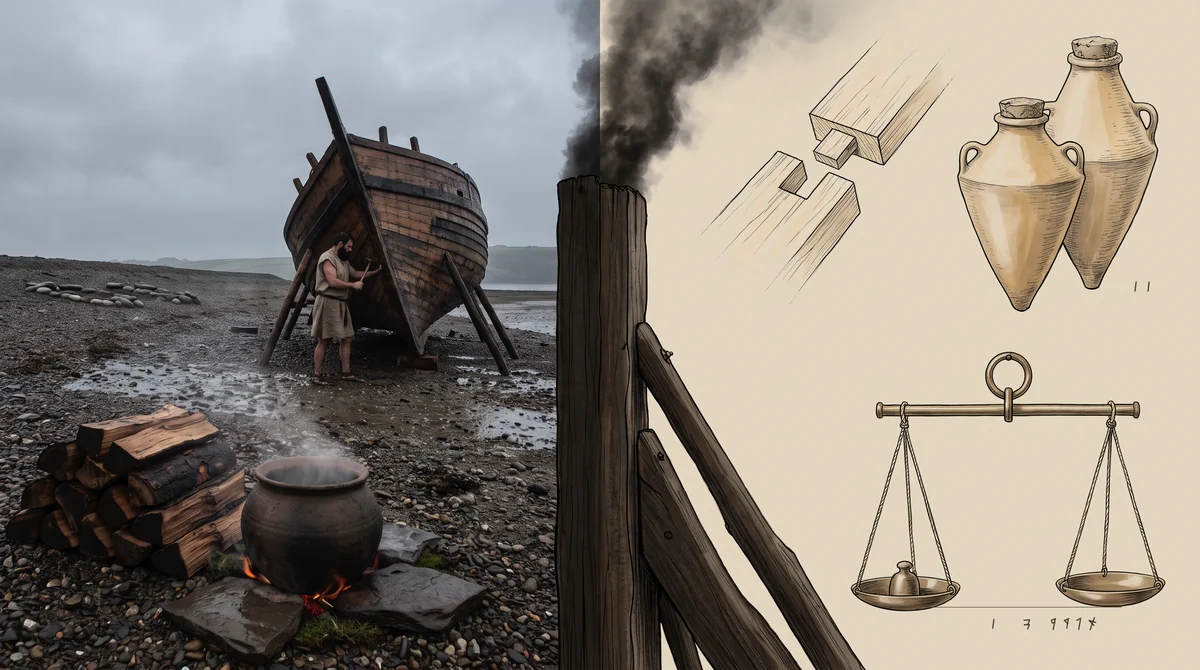
“There’s no sour wood. There’s pitch gone hard and some gone soft, and a seam here where the water’s been in and out of it since Uxisama. I can smell the sea in the pine. If she sits quiet she’ll take up. If she’s put through another race like that one I want a jar of pitch and a day on a beach.”
“There are two jars of pitch. One broached, one sealed.”
“One sealed jar, if she’s beached. I’ve smelt the open one.”
Shafat went aft to the broached jar of pine pitch, which was lashed under the steering bench beside its sealed fellow. He took the stopper out. The pitch stood two fingers below the rim. He put the stopper back and pressed it down and looked at the place where it met the neck of the jar.
Then the leads.
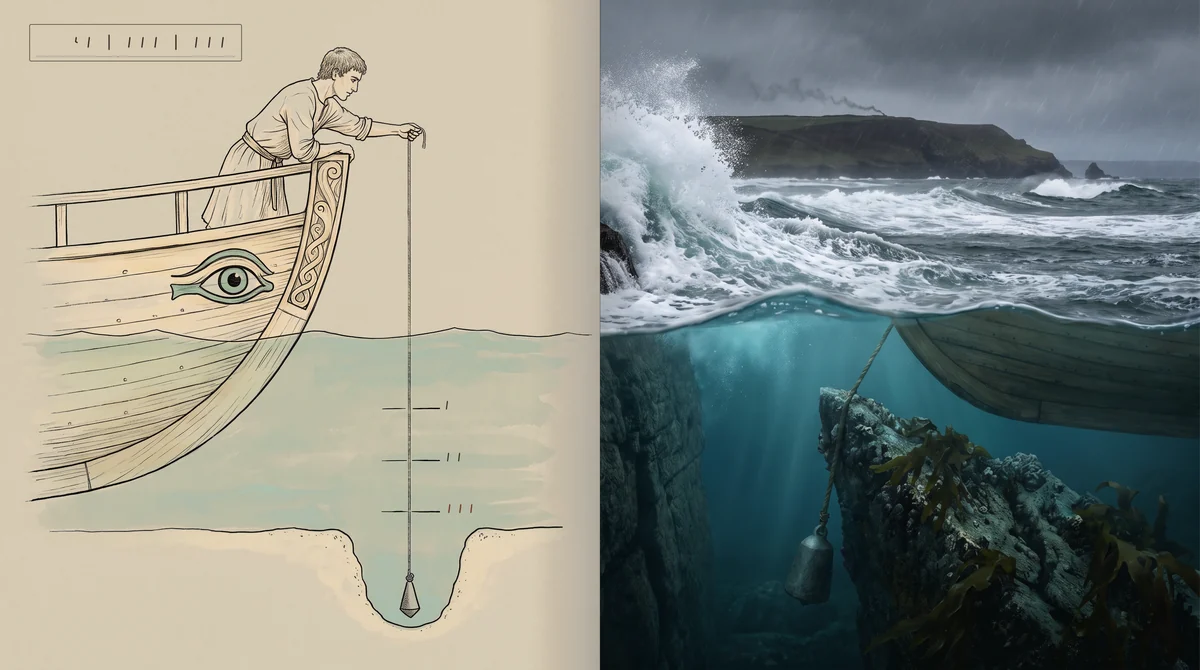
The heavy lead hung on its peg beside the steering oar. It was a bell of grey metal the length of his forearm with an eye cast in the top for the line and a hollow in the foot, and the hollow was packed with tallow. He took it down and turned it to the light and looked at the tallow. It was clean. The last cast had been in the race and had found no bottom, and he had cleaned the hollow and repacked it himself before they came under the rock. The line was coiled in its basket beneath the peg. It was marked at every fathom with a tag of leather and at every fifth fathom with two tags. He hung the lead back on its peg.
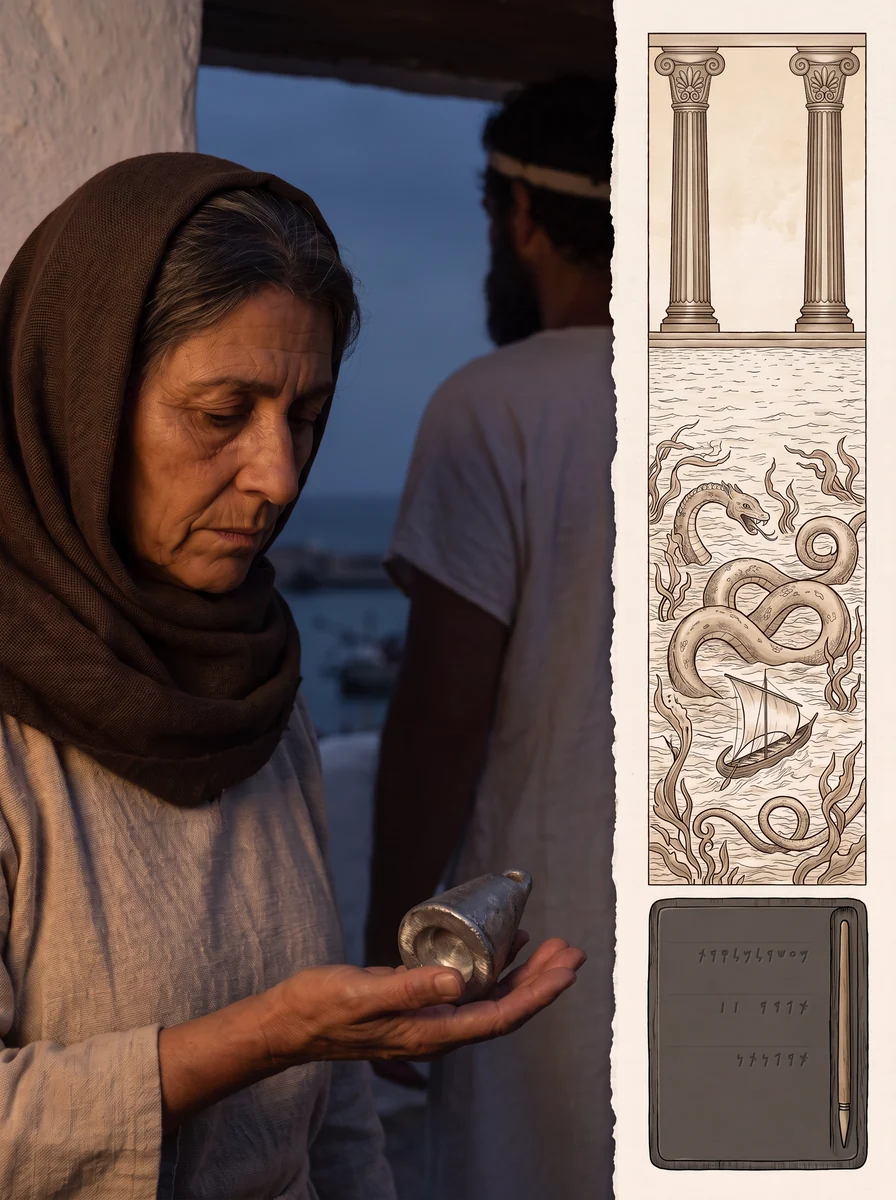
The light lead was not his. It hung at the clerk’s belt. It was the size of a child’s fist, old, with an eye worn thin, and it had come aboard at Gadir on the boy and had never been entered in any list of the ship. It had a cord of plaited flax and a hollow in its foot no bigger than the end of a thumb. Shafat had seen the boy pack it with tallow from his own ration of fat and drop it over the side on calm evenings and pull it up and look at what was in the tallow, and smell it, and wipe it clean. The boy had said that it had been his father’s.
Two leads, then. One heavy line, marked to forty fathoms. One light line, unmarked.
Then the Greeks.
He did not go anywhere to think about the Greeks. He stood by the steering oar with his hand on its loom and put the facts in order as he had been putting them in order since Gadir.
For two summers running the harbour pilots had reported Massaliote ships at the river-mouths north of Gadir, buying tin that had come south across the land and had never passed through Gadir at all. If the Greeks found the sea road to the tin as well, the Council of Gadir would have no tin left to sell, and within the lifetime of the men now on the benches the sanctuary of Melqart would be answering to the kings of the mainland or to Carthage, whichever came first to take it.
That was the order of the facts. He had been sent to change one of them.
Admiral Himilco had given him the order on the beach under the Oestrymnic headland, with the pilot standing at a distance in the surf and the two judges’ seal on the commission between them on a flat stone. Find the tin. Find the water to it. Set it down so that a steersman of Gadir who has never seen it can find it again without asking anyone. Be at the headland at the dark of the next moon.
The moon had been dark last night. It would be dark again in twenty-nine days.
The pilot’s boat had not come under the rock.
It lay off the western end of the black rock, beyond the place where the swell lifted white over a ledge, and the pilot sat in its stern with his paddle across his knees and watched the ship. It was a boat of hides stitched over a frame of hazel and oak. Shafat had counted seven hides along its side from the Oestrymnic headland to here, at every distance and in every light, and seven was what it had. Four men paddled it. A fifth, a boy of about fifteen, sat on the forward thwart. The pilot had brought them across the western sea in two days and a night, never more than a cable from their bow, and had refused at every dusk to come alongside, and had eaten nothing that the ship sent down to him.
Now he was paddling in.
Shafat sent for the clerk.
The boy came up from the hold where he had been sleeping against the tablet-box with his cloak over his head. He was seventeen or near it, long in the arm, with the Tartessian habit of carrying his chin forward. He had the cargo board under his arm and the light lead at his belt and wax on the fingers of his right hand. He stood at the rail beside Shafat and put the board down on the rail and his hands on the board.
The hide boat came alongside below the forward benches. Its side touched the pine and gave a little and came back. The pilot did not hold on to the ship. He held his boat off the strakes with the flat of his paddle and looked up.
He spoke for some time. The clerk listened with his head on one side.
“He says,” the boy said, in the speech of Gadir, “he says that the place we are looking at, the smoke and the river and the ford under it, belongs to a woman, a smelter, she holds the stream, and she has tin, he thinks a score of ingots, which is twenty, a score is how they count—and he says he will carry a mouth of ours to her at dawn, in his boat, and bring it back to us before dark.”
“What does he mean by a mouth?”
“A speaker. Me. He means me—no, he means anyone who can carry words, but I am the only one aboard who has his speech, so he means me.”
“And what does he ask?”
The boy asked. The pilot answered in fewer words than he had used before.
“He says that when a mouth of ours goes ashore, a surety of his comes up. A pledge. He says that is the custom of the ford, and of his headland, and that otherwise a keel can carry off the mouth of a stranger and the stranger has no one to ask for it back.”
“Who is the surety?”
The boy asked again. The pilot did not turn his head. He lifted his paddle and pointed it at the boy on the forward thwart, and the boy on the forward thwart grinned up at the rail.
“His sister’s son,” the clerk said. “Tancinos. He says—he says the boy is worth more to him than the tin is to us, and that you should know it so that you will feed him properly.”
Shafat looked down at the hide boat.
“Tell him no,” he said. “Tell him that the ship of the Council of Gadir does not keep hostages from the people it trades with, and that the clerk will go ashore under the protection of the Council.”
The boy began to say it. The pilot listened to the end. Then he dug his paddle in and the hide boat moved its own length away from the ship and lay there, and the four men in it rested on their paddles, and the pilot looked at the smoke.
Shafat put the matter in order.
Eleven jars. Fourteen days at the ration set from dawn. A spring under the smoke, which belonged to the woman who held the stream. No other spring known on this coast, and the headland spring shut against wooden hulls. Himilco’s order, which said tin, and water, and a road to both that a Gaditan steersman could follow without asking. A road that could not be found without the pilot at least once. Twenty-nine days to the dark of the moon. A pilot who had now been given a reason to go home.
The pilot had asked for a surety in the hearing of fifty men of Gadir. Shafat considered the possibility that the pilot was raising his price, since he had already been paid at the headland for the crossing and had nothing further to sell but the next step. He considered that the boy, Tancinos, would be fed from the ship’s stores and would drink from the ship’s water, and he made a note of it to be corrected. He considered that a pledge in the hand of the ship would oblige the pilot to come back, which was worth more to the ship than anything the pilot would gain by it.
“Call him back,” he said.
The clerk called. The hide boat came back to the strakes.
“Tell him that the Council of Gadir accepts the custom of the ford for the length of this trade. Tell him that his sister’s son will eat from the steersman’s bowl and sleep on deck by the stern. He may go anywhere above deck except the hold. He will not be bound. Tell him that the boy will not drink our water. He will bring his own.”
The clerk told him. The pilot spoke a few words to the boy on the thwart without looking at him, and the boy reached under the thwart and brought up two skins of water, each the size of a lamb, and slung them round his neck by their thongs.
“He says the boy brings his own water anyway,” the clerk said. “He says—he says he wouldn’t drink ours, not from a hull that’s been as far south as ours has, he says that water from the south tastes of the south.”
“Write it,” Shafat said.
“Which, the water?”
“The pledge.”
The sun went down behind the black rock while the boy was still in the hide boat. Shafat let him stay there.
He went aft to the steering bench where the small bronze cup was kept in a niche cut into the bench-end and lined with wool. He took the cup out. The day’s issue hung beside the niche in a goatskin, drawn from the stock jars at dawn and already entered against the day, and he filled the cup from it to the lip. He stood at the stern rail and held the cup in both hands and said the words that are said at Gadir when the sun goes into the western sea, in the name of the lord of the city, and poured the water over the stern. The water went into the sea beside the steering oar.
He put the cup back into its niche. Then he took the clerk’s cargo board from the rail where the boy had left it, and the stylus that hung from it on its thong, and wrote at the bottom of the day’s column, in his own hand, the word for loss and the number for one cup. Then he went down into the hold and counted the stock again, nine full, four at half, eighteen empty, and came up and said the number to Bostar, who repeated it. Eleven. That was the count for the night, and it was not to be changed before dawn.
Abdmilqart had been watching him from the mast.
The assessor of the sanctuary was the only man aboard who did not row, steer, or sound. He had come aboard at Gadir with a cedar chest the size of a child’s coffin bound in bronze at its corners, and the seal of the sanctuary hung from a cord around his neck. He was older than Shafat and taller, with a long grey beard he oiled every morning from a flask of his own. He wore linen when every other man aboard had gone into wool after the cape, and he had not been sick once on the whole voyage.
“You enter the god’s cup as loss,” Abdmilqart said.
“I enter what leaves the jar.”
“It is not lost. It is given.”
“It is given and it is gone from the jar. The ledger of water is for the men who drink it. The god is not on the bench-muster.”
Abdmilqart came aft with his hands behind his back. He looked at the cargo board and the word for loss written at the bottom of the day.
“Then let it be entered in the god’s ledger as given,” he said, “so that when the tenth is reckoned at Gadir nobody can say that the trierarch made the god’s portion out of the crew’s.”
“There is nothing yet to take a tenth from.”
“There will be. I have come to seal the chest empty, before witnesses, so that what goes into it afterwards goes into it before witnesses.”
“Seal it.”
The chest was lashed to two ring-bolts against the mast-step. Abdmilqart called Gisco and Bostar to stand beside it. He opened the lid on its bronze hinges and tilted the chest towards the light from the west so that the two men could see that it was empty, with nothing in it but the smell of cedar and a fold of clean linen in the bottom. He closed the lid. He took a pellet of clay from a pouch at his belt and pressed it over the cord that ran through the lid-hasp and the hasp on the body, and took the seal from round his neck and pressed it into the clay. Then he stood up.
“Empty,” he said. “Before Gisco, before Bostar, before the trierarch.”
“Empty,” Gisco said.
Bostar said it also.
Maharbal was being sick over the side.
He was the youngest of the marines, a farmer’s son from the mainland opposite Gadir, and he had been sick at sea every day since the cape. At anchor he was worse than under oars. The swell came round both ends of the black rock and met in the lee and lifted the ship and put it down at an angle that did not repeat, and Maharbal hung over the starboard rail with his spear lying on the bench behind him and brought up what he had not eaten.
“Take his spear off the bench,” Shafat said. “If it goes over the side I will pay for it from his share.”
One of the older marines took the spear.
Maharbal straightened up and wiped his mouth with his wrist. He looked at the smoke on the slope and said that at least the land here did not move.
“It moves,” Bostar told him. “Twice a day it comes up to meet you and twice a day it goes away again. You’ll get used to it.”
The clerk came up out of the hide boat with his cloak wet to the waist. Shafat had him stand by the steering bench.
“At dawn you go ashore with the pilot,” Shafat said. “You will carry the price the woman asks, and you will carry it back to me, and you will agree to nothing that is not a price. Do you understand?”
“I understand—yes. I’ll carry it back. And if she asks what we’re paying with, should I say oil, or should I wait until she—”
“Say oil. Say sweet oil, in sealed jars. Say forty jars if she asks for a number, and do not say forty if she does not.”
“Forty.”
“And you will take your father’s lead.”
The boy looked at the lead on his belt and then at Shafat.
“I always take it.”
“You will take it with tallow in it. When the pilot’s boat goes over the bar, you will let it down over the bow on its cord as a boy lets down a line to fish. You will let it touch bottom and bring it up and let it down again. You will count the cord in arm-spans each time it touches. You will not write anything in the boat. You will keep the count in your head, and you will keep the tallow in the lead, and you will bring both back to this ship.”
“And if he sees me?”
“Then you are a boy fishing.”
The boy wiped his hands down the front of his wet cloak. His wax-stained fingers left four short marks on the wool.
“With lead, though,” he said. “They don’t fish with lead here, I think, they use stone, or—no, they must use something, they must sink their lines somehow. I’ll ask him. I’ll ask him what they fish for in the river and then I’ll be—I’ll be fishing for that.”
“Do not ask him anything,” Shafat said. “Let your lead down and count.”
He filled his own horn cup from the issue skin and gave it to the boy. The boy drank half and held it out. Shafat took it and drank the other half.
When the light had almost gone he dictated the pledge.
The clerk sat on the steering bench with the cargo board across his knees and the lamp hung from the stern-post above him. The cargo board was a single leaf of boxwood in a frame, waxed black, kept for what came on and went off the ship. The bound tablet, the two leaves for the road and its soundings, lay in the tablet-box below, blank. Shafat had not yet opened it in this sea.
“Under today,” Shafat said. “Received.”
The boy wrote. The wax was cold and he had to lean on the stylus.
“Pledge. Oestrymnic. Male.”
The boy wrote each word. Between each word he looked up at the hide boat, which had come alongside below the forward benches again with its seven hides squeezed against the pine.
“One,” Shafat said.
The boy wrote the number. Then he held the stylus above the wax.
“Should I put his name?” he said. “I have it. Tancinos. It’s—he says it means something, something to do with peace or with a tribe, I didn’t get it all—and if we write only ‘pledge, male, one’ and something happens to him, there’s nothing in the wax to say which one, and if his uncle—”
“There is only one,” Shafat said. “Put the board away.”
Down in the hide boat the pilot said something short to his sister’s son. The sister’s son stood up on the forward thwart with the two water-skins slung across his chest and put both hands on the top of the strake. The hide boat dipped under his weight and came up. He pulled himself up and over the rail in one movement, and one foot came down on the pine deck-strake inside the rail, bare and wet, with sand still on the heel.
Shafat counted him. Nine full, four at half, eighteen empty, one pledge. Then he went forward to look again at the two cracked thole-pins.